Outreach/News
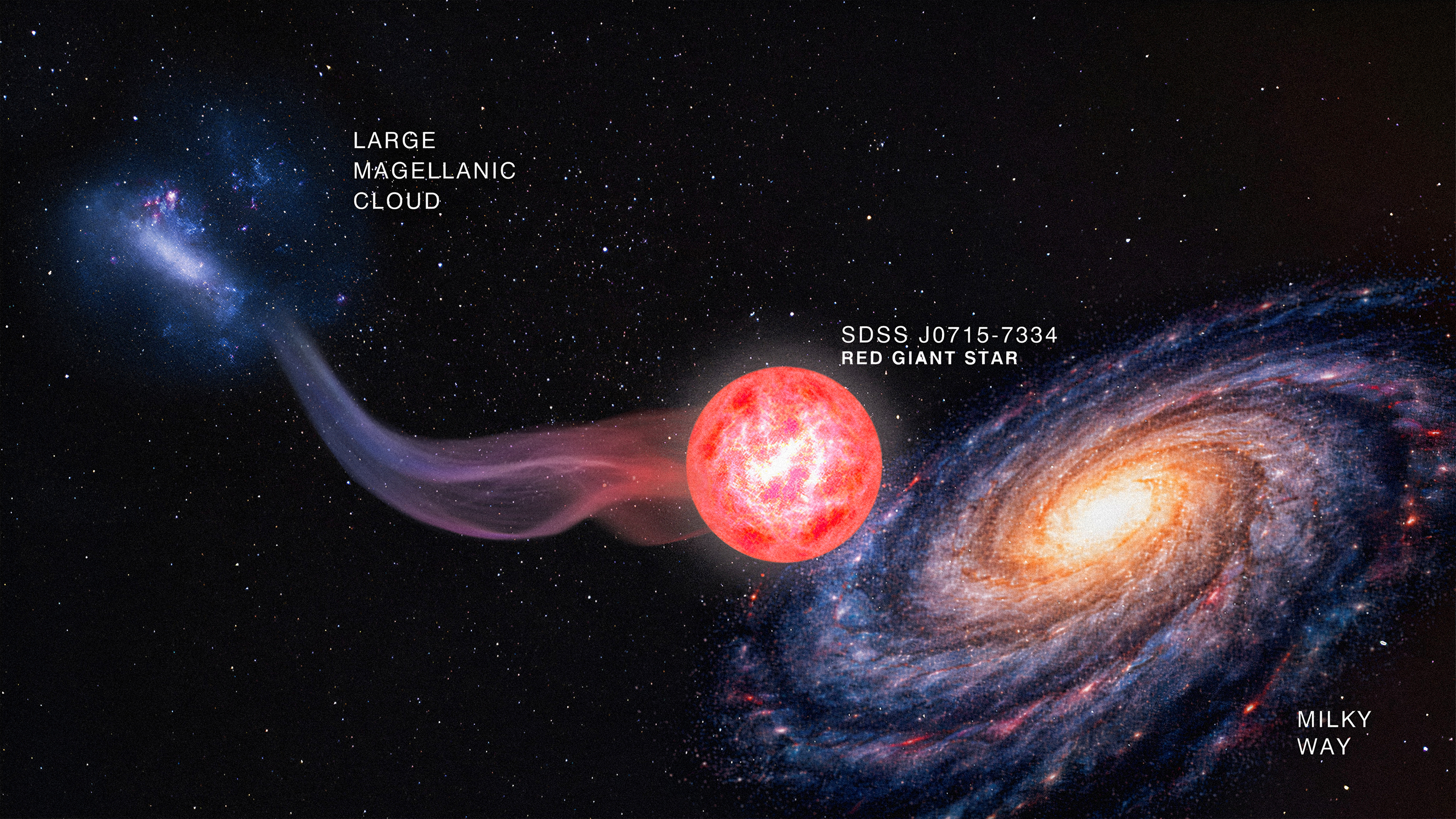
A Nearly Pristine Star from the Large Magellanic Cloud.
We found a star in SDSS-V and showed that it has the most pristine chemical composition of any object known. It is an ancient immigrant, born in or near the Large Magellanic Cloud but now exists in the halo of the Milky Way. It is one of two known objects that is so metal poor that its formation requires the presence of a sprinkling of early dust grains. The star was found and followed up by UChicago undergraduate students in our Astronomy Field Course. The paper is out in Nature Astronomy (PDF). A collection of articles from UChicago, SDSS-V, Carnegie Science, and several others.
 |
|---|
| Illustration of star going from LMC to Milky Way |
| Image Credit: Navid Marvi/Carnegie Science |
Spectacular Nucleosynthesis in Early Massive Stars
We discovered a star with spectacular chemical composition in SDSS-V. It implies an explosion of an ancient star so massive that it should not have exploded, but we are at the limits of our theoretical supernova models. The paper is out and you can see my AAS press conference on YouTube. A collection of articles from UChicago, SDSS-V, Astrobites, Starts with a Bang, Calfornia Academy of Sciences, ScienceAlert, Science Reader, Phys.org, and others. We were also featured as a Sloan Foundation Highlight (full magazine).
 |
|---|
| Illustration of stellar archaeology, showing elements measured in the star J0931+0038. |
| Left: Illustration of supernova explosion with elements flying out from the center. |
| Right: Red giant star with pullout showing elements measured. |
| Image Credit: University of Chicago/SDSS-V/Melissa Weiss |
Popular Science Programs
I have been a scientific advisor for a few popular science videos.
Twelve for Dinner
The S5 collaboration published the first 6D map of twelve distant stellar streams (paper) that will help reveal the dark matter distribution in the Milky Way. Press from UToronto, see details at our website.
An extended halo around an ancient dwarf galaxy
Anirudh Chiti led a paper detecting the very outskirts of the dwarf galaxy Tucana II. This is the furthest out that stars have been detected around a tiny galaxy. The paper is published in Nature Astronomy. A collection of press from Carnegie, MIT, The Guardian, CNN, Sky and Telescope.
A primitive stellar stream
The S5 survey has discovered the most metal-poor known globular cluster in the Milky Way. It is being actively tidally shredded by the Milky Way. A collection of news articles from Carnegie, VICE, Sydney Morning Herald, Sky and Telescope, Chicago Tribune (in Spanish), and CNET. The Galactic Times produced a podcast about the Phoenix stream.
A hyperfast runaway star
The S5 survey serendipitously found the first known star to be kicked out from our galaxy’s central black hole. Here are a collection of news articles from Carnegie, the New York Times, CBS News, and Space Australia.
The First Stars, Like, Ever
In 2020 I gave an online talk at Astronomy on Tap with Dr. Brittany Kamai. You can watch it on YouTube!
Glimpses of the Cosmic Dawn
In 2019 I gave a talk at the Huntington Libraries about “Glimpses of the Cosmic Dawn”, which you can watch here:
Searching for the First Stars
In 2017 I gave a talk titled “Searching for the First Stars” at the Carnegie Observatories Open House. You can watch it on YouTube!
The R-Process Galaxy Reticulum II
My favorite galaxy is Reticulum II.
News article by Carnegie Science
New in 2021! Update on the search for gold

The nine brightest stars in the r-process galaxy Reticulum II are circled.
Three of these stars are highlighted, showing their large barium content.
The Caterpillar Project
Check out The Caterpillar Project. Here’s a quick video showing what it’s about. Video production credit to Brendan Griffen.